Buildings Don’t Break, They Drift: How Continuous Building Savings Finds the Waste
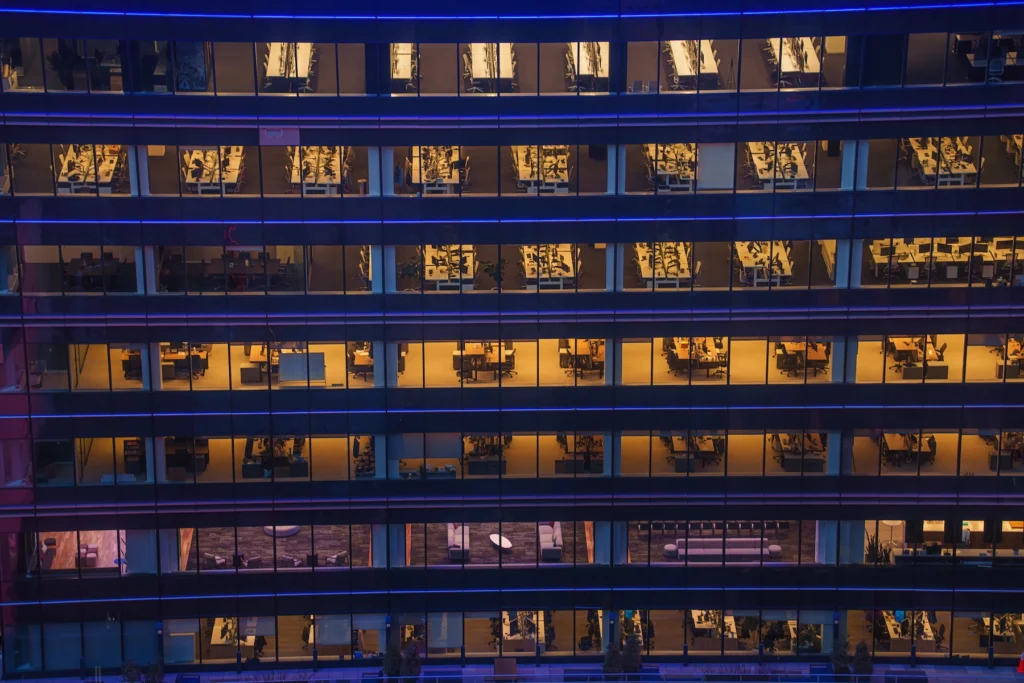
Nothing alarms when a building starts wasting money
A commercial building rarely fails in a way anyone notices. It drifts.
A damper is commanded to 30 percent and sits at 60 because a linkage slipped two summers ago. A floor conditions to 70 degrees at 2 a.m. because someone overrode a schedule for a tenant who moved out three years ago. A heating setpoint creeps above a cooling setpoint in one zone, and the two sequences fight each other every afternoon while both meters run.
None of that trips an alarm. The space is comfortable, the occupants are quiet, and the utility bill is only a little higher than last year. Multiply a little higher by every zone, every hour, and every month, and the number stops being little.
- ~40% of the energy used in US commercial buildings goes to heating, cooling, and ventilation (EIA, Commercial Buildings Energy Consumption Survey)
- ~1/3 of a typical office building’s operating budget is energy, its single largest and most controllable operating expense (EPA ENERGY STAR)
- +27% commercial electricity prices since 2020, so the same drift costs more every year (EIA)
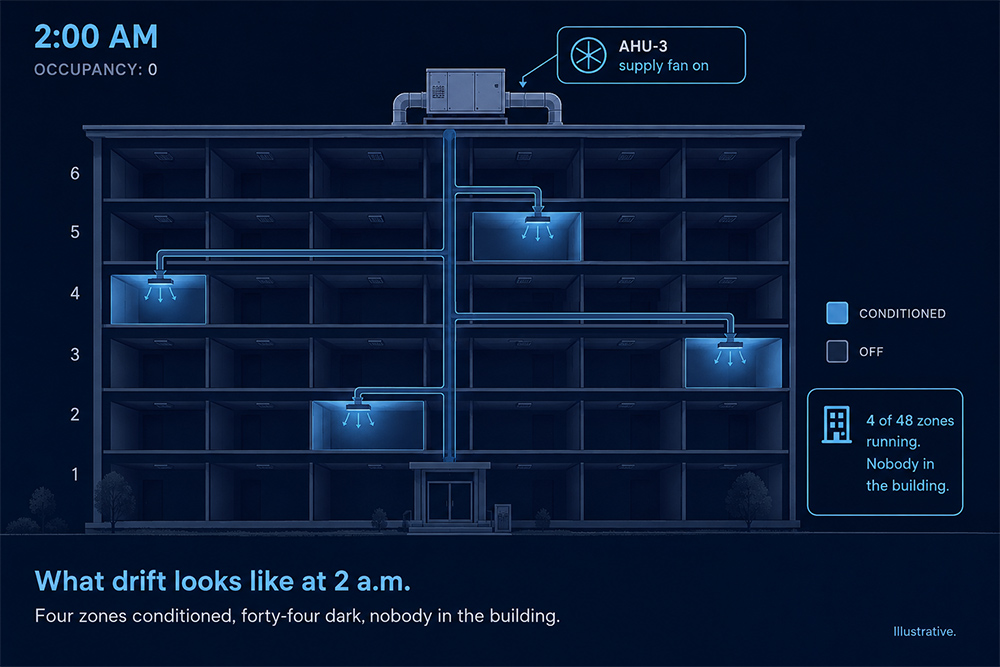
What drift looks like at 2 a.m. Four zones conditioned, forty-four dark, nobody in the building. Illustrative.
An audit is a photograph. A building is a film.
Two tools usually get pointed at this problem, and they fail in opposite directions.
A retro-commissioning study or an energy audit produces an accurate picture of the building during the week an engineer walked it. It is genuinely useful the day it lands. Then tenants move, seasons turn, a controls contractor makes a change to close out a hot call, and the picture goes stale. Many owners repeat the exercise only every several years, which means the building spends most of its life operating against findings that no longer describe it.
Fault detection goes the other way. It watches continuously and flags everything, which is how a facilities team ends up with four hundred open alerts and no way to tell which three are worth a Tuesday morning. A flag without a dollar figure attached is not a decision, it is a chore.
The hard part was never observation. It is knowing which of the things a building does wrong are worth someone’s time this month.
That is the view we set out to build: not more alerts, but a short list, priced, and reordered every month as the building changes. Here is roughly what an owner sees.
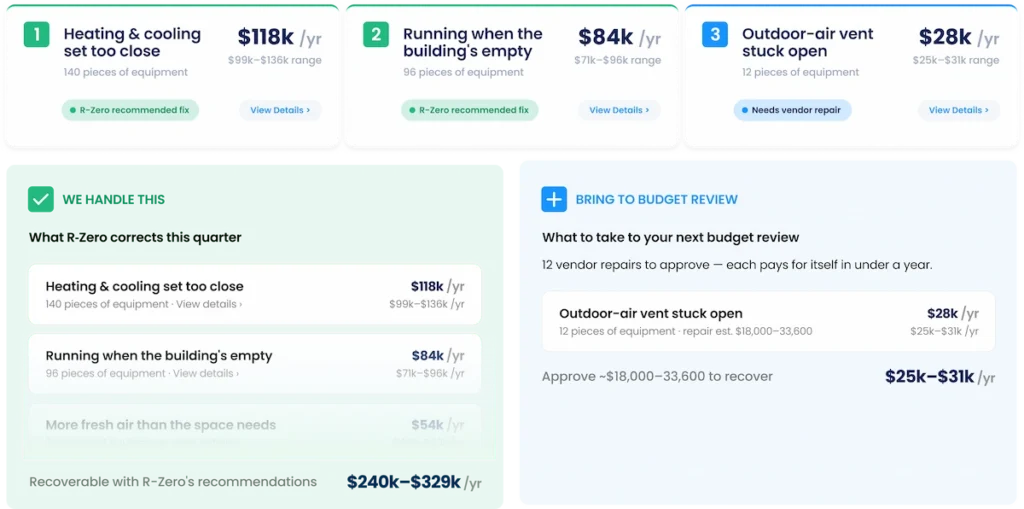
Product mockup. Illustrative sample for an approximately 1.2 million sq ft office. Projected figures, not a customer result.
Eight behaviors that quietly cost money
These are the patterns we go after first. None of them require new equipment to correct, and most are a setpoint, a schedule, or a sequence. Recommendations follow industry-standard practice, including ASHRAE Guideline 36 sequences, and several carry a California Title 24 §120 citation where the jurisdiction applies.
- Runs when the building is empty
Equipment conditioning space nobody occupies, usually a schedule nobody revisited or an override left in place after a one-time request. - Heating target above cooling target
The two sequences chase each other in the same zone. Both systems run, the space lands somewhere in between, and you pay twice for it. - Comfort band too narrow
A two degree deadband where four would do keeps equipment cycling all day to hold a difference no occupant can feel. - Heating and cooling at once
Reheat working against central cooling on the same air. It is the most expensive way to hit a setpoint, and it is common. - More outside air than code requires
Conditioning air the building has no obligation to bring in. We identify the excess above code, never a reduction below it. - Free cooling used when it costs money
The economizer opens on outside air that is more expensive to condition than the return air it displaced. - Free cooling available but unused
The reverse case. Mild outside air passing the building while mechanical cooling carries the whole load. - Damper ignores its command
The sequence is correct and the hardware is not following it. This one is a work order, and knowing it costs you $9,000 a year changes how fast it gets written.
We also assess whether a building is a good candidate for occupancy-driven ventilation optimization, which is a separate strategy the platform can unlock.
A finding is only useful if someone can act on it
Every finding carries five things: what the building is doing, the equipment data that shows it, the estimated annual cost of leaving it alone, the cost to correct it, and the specific change a contractor would make. That last part matters more than it sounds. A finding phrased as an anomaly score gets forwarded. A finding phrased as a setpoint, a schedule, or a sequence gets fixed.
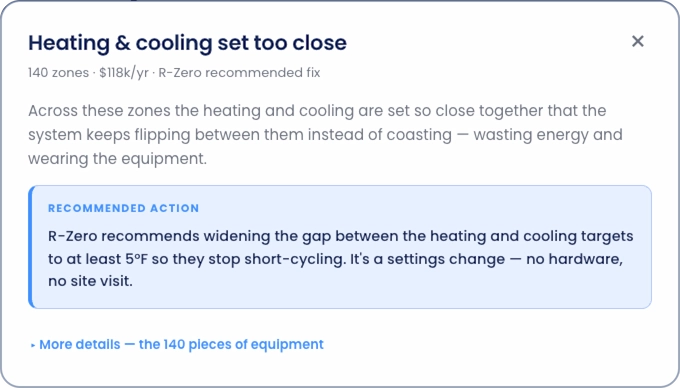
Product mockup. Illustrative example of a single finding. Projected figures, not a customer result.
The same package is what a building engineer or a utility incentive program needs to verify the result independently. Where the available data cannot confirm a behavior, the finding says so and names the instrumentation that would close the gap. An honest we cannot see this yet is worth more than a confident guess.
Ranked by dollars, cheapest fixes first
A building will hand you more things to fix than you have budget or Tuesdays for. So the list is ordered by annual dollar impact, and within that, the corrections that cost nothing sit at the top. Setpoint and schedule changes usually come first because they return money in the same month they are made. Capital repairs come later and arrive budget-ready, with the return already calculated so the request survives the finance conversation.
R-Zero does not sell HVAC equipment and does not bill service hours. The ranking reflects your return, not our margin.
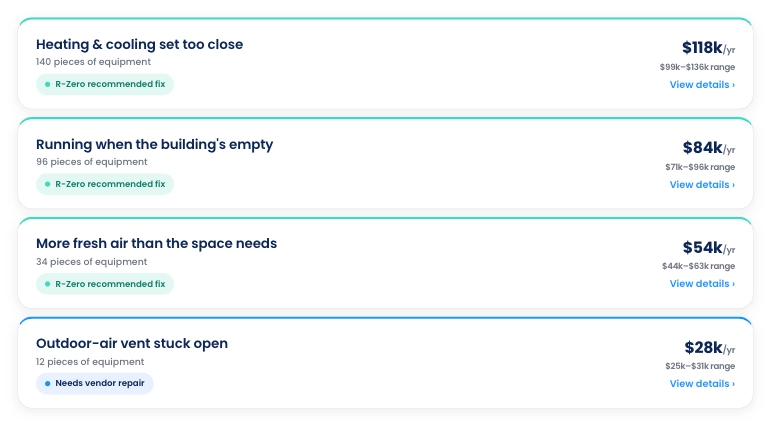
Product mockup. Illustrative sample report, projected ranges, not a customer result. Every building’s numbers come from its own data.
One gateway, outbound only, bounded by design
All of this reads the building management system you already have, over BACnet/IP. One gateway, vendor neutral across controls brands, no new HVAC hardware, no rewiring, and no rip and replace. If your building has a BMS with addressable air handlers and terminal units, the data needed to start is already being produced and mostly already being discarded.
Because this sits next to operational technology, the constraints matter as much as the capability.
Guardrails:
- Outbound only, encrypted over TLS on ports 443, 7844, and 8883. No inbound connections and no ports opened.
- Where writes are supported, they are bounded by commissioned limits and sit below operator and life-safety priority.
- Writes release automatically on loss of communication, and there is a manual kill switch.
- We never touch life-safety sequences and never take ventilation below code.
- SOC 2 Type 2 certified.
The list is never finished, which is the point
Correcting a finding does not close the file. Buildings keep moving: a tenant takes another floor, a chiller is replaced, a controls contractor makes a change to solve a hot call and quietly reintroduces something you fixed in March. Continuous analysis holds the corrections in place and surfaces what appeared since the last report.
Find out what your building is doing at 2 a.m.
Every building is already producing the evidence. Continuous Building Savings reads it, prices it, and tells you which three things to fix first.
See how it works