
From Data to Decisions: How Room Intelligence Turns Building Usage Into Real Performance Gains
Every building generates occupancy data. Sensors count people entering and leaving rooms. Badge systems log entries. Booking platforms track reservations. But for most organizations, that data sits in silos, disconnected from the systems that actually control how a building operates.
The result is a persistent gap between how spaces are used and how buildings run. HVAC systems ventilate for assumed capacity. Space planning relies on anecdotal feedback. Facilities teams make decisions without a consistent, building-wide picture of what’s actually happening at the room level.
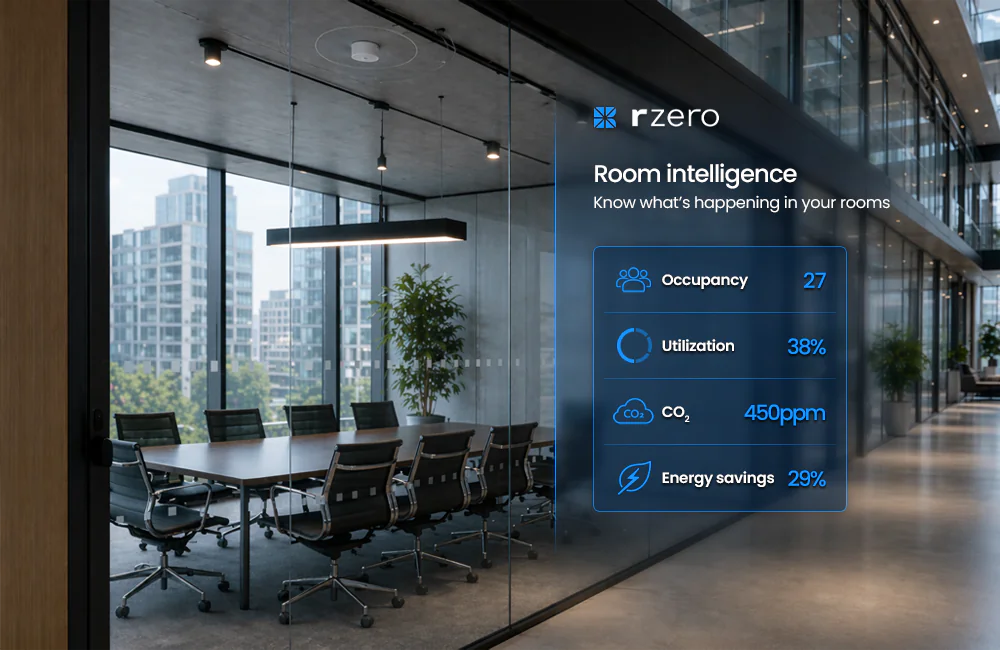
Today, R-Zero is launching Room Intelligence within the Connect platform, a new capability in R-Zero’s Physical AI system designed to close that gap. Room Intelligence translates real-time room-level utilization into operational intelligence that can be used to directly reduce energy consumption, optimize ventilation, and make better decisions about how space is configured and used.
The Problem: Plenty of Data, Not Enough Clarity
Facilities, workplace, and real estate teams manage buildings by rooms, floors, and zones. But the data they rely on rarely matches that structure. Occupancy counts may be tied to individual sensors rather than the rooms those sensors serve. Utilization metrics are often aggregated at the building level, making it difficult to see which specific spaces are underperforming or overbooked.
This fragmentation makes it difficult for teams to understand to answer questions about how a building is actually used. Questions like, which conference rooms are consistently in demand? Are rooms sized correctly for the groups that actually use them?
These aren’t abstract analytics questions. They’re the inputs to real decisions — lease renewals, floor reconfigurations, HVAC scheduling, and capital planning. When the data isn’t structured around how teams actually manage space, those decisions get made on instinct rather than evidence.
What Room Intelligence Does
Room Intelligence unifies multiple data inputs into a single, room-level view inside Connect. Rather than presenting raw sensor counts, it organizes occupancy data by individual rooms, grouped by floor or zone, and comparable across a portfolio.
With Room Intelligence, teams can:
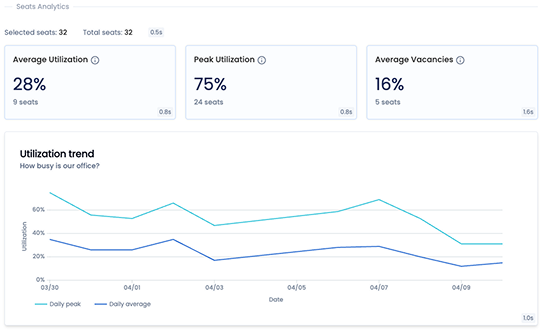
- See how each room is used over time, including frequency, duration, and group size patterns
- Compare utilization against capacity to identify mismatches in space design
- Identify opportunities to rebalance room types, adjust layouts, or consolidate footprint
- Feed real-time usage patterns into operational systems that control energy and ventilation
“Buildings are full of data. What’s missing is a clear way to turn it into decisions teams can actually act on,” said Jennifer Nuckles, CEO of R-Zero. “Room Intelligence connects how spaces are actually used to how buildings operate, so energy, ventilation, and space decisions can adjust dynamically in real time.”
From Insight to Operations: Why Room-Level Data Matters
Utilization data is only as valuable as the decisions it informs. Room Intelligence was designed not just to surface patterns but to connect them to the operational systems that determine building performance.
Consider ventilation. Most commercial buildings still operate HVAC systems based on assumed peak occupancy, running at full capacity regardless of how many people are actually in the building. By structuring occupancy data at the room level and feeding it into building management systems, organizations can align ventilation with actual demand. That’s the foundation of occupancy-based demand control ventilation, and it’s where R-Zero has demonstrated up to 20%-40% total HVAC energy reduction.
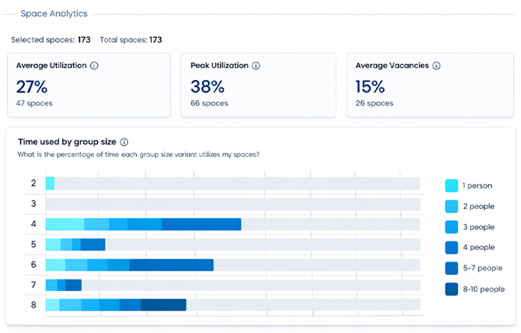
But the value extends beyond energy. Room Intelligence also strengthens the connection between space utilization and real estate strategy. When teams can see that a floor of 12-person conference rooms is routinely used by groups of three or four, that insight directly shapes decisions about layout reconfiguration, lease negotiations, or footprint consolidation. The data moves from a dashboard into a decision.
Built for How Buildings Are Actually Managed
One of the key design principles behind Room Intelligence is alignment with how teams actually work. Facilities managers think in terms of rooms, floors, and buildings, not sensors. Workplace teams evaluate space by function: huddle rooms, large conference rooms, and open collaboration areas.
Room Intelligence reflects that reality. It organizes data into a structure that maps to a building’s physical and organizational hierarchy, making it immediately legible to the people who need it most. Instead of requiring teams to interpret fragmented sensor data and translate it into spatial context, Room Intelligence does that work automatically.
Physical AI in Practice
Room Intelligence is part of R-Zero’s broader physical AI platform: a system that translates real-time data from the physical environment into continuous optimization of energy, space, and operations.
Where many building technology platforms stop at reporting, R-Zero’s approach is designed to close the loop between sensing and action. Occupancy data feeds into ventilation control. Utilization patterns inform space planning. Energy performance is continuously monitored and optimized. Room Intelligence strengthens this foundation by ensuring that the data flowing into these systems is organized, accurate, and aligned with how buildings are actually operated.
As organizations look to reduce operating costs and improve asset performance, the ability to make precise, room-level decisions — and connect those decisions to building systems in real time — becomes a meaningful operational advantage.
Get Started
Room Intelligence is available now in Connect for all existing and new R-Zero customers. To see how room-level utilization data can improve energy performance and space decisions across your portfolio, reach out to your R-Zero representative.