Optimizing Event Spaces: Utilization Insights from IFMA World Workplace 2025
For the second year in a row, R-Zero was proud to partner with the International Facility Management Association (IFMA) to deploy smart sensors throughout the World Workplace 2025 conference. By monitoring occupancy, environmental quality, and traffic patterns across the conference, we captured utilization data that tells a story. The insights reveal actionable opportunities for event organizers: from identifying which session rooms need right-sizing to planning around peak engagement times.
IFMA Central: Where Collaboration Happens
IFMA Central served as the networking heart of the World Workplace conference, and the utilization data confirms it functioned as a true gathering space for connection and collaboration. This area saw the highest activity on Thursday (9/18) at 10 AM, marking an optimal time for programming, networking events, or key announcements when attendee presence was at its peak.
Overall, average utilization across IFMA Central workstations was up to 60%, a strong indicator of steady, sustained engagement throughout the multi-day event. However, not all zones performed equally.
High-Engagement Zones:
- IFMA Meet-Up Lounge: 86% utilization
- IFMA Credentials Desk: 87% utilization
These high utilization metrics indicate that these areas were staffed throughout the event or became natural gathering locations. Strategic placement of such anchor points creates traffic flow and encourages spontaneous interaction, an important consideration in event space design.
Medium-Engagement Zones:
- IFMA Membership Desk: Up to 40% utilization
- IFMA Foundation Desk: Up to 42% utilization
- IFMA Meet-Up Lounge: Up to 44% utilization
These spaces became natural congregation points, potentially thanks to their proximity to the Podcast Corner. Attendees came for the scheduled content and then stayed to network — exactly the kind of organic collaboration that well-designed hubs should foster.
Environmental Data Reveals Collaboration Intensity
Real-time air quality and acoustic monitoring provided additional context beyond occupancy counts. CO₂ levels peaked between 3-5 PM on Wednesday (9/17), coinciding with a sharp spike in noise levels. These dual indicators not only signal which spaces drew crowds, but also where the crowds were collaborating. When looking at the day’s schedule, this spike in CO₂ levels makes sense; attendees were gathering in IFMA Central for the daily prize drawings.
Conference Rooms: Understanding Demand to Right-Size Spaces
Session attendance data revealed clear patterns about content popularity and timing preferences.
Thursday’s sessions consistently attracted the largest audiences compared to Friday’s education sessions — all valuable intelligence for scheduling keynotes, popular tracks, or sponsor presentations at future events.
Room 103DE stood out as the busiest conference space, with attendance at times exceeding 100% capacity. Attendees stood in aisles or crowded doorways, particularly during sessions scheduled between 1–2 PM and 4–5 PM. Room 102DE also reached over 100% capacity around 5 PM on Thursday for the “You Talkn’ To Me? Effective Communication Using EQ” session, indicating similar demand challenges.
High attendance metrics signal to event organizers that the content presented at these times resonated with attendees. This data highlights a clear directive for space planning at future events: match room capacity to expected demand based on topic, speaker, and time slot.
- High-demand topics and keynote speakers: Larger rooms or multiple time slots
- Niche or technical deep-dives: Smaller, more intimate spaces
- Peak time slots (1–2 PM, 4–5 PM): Reserve larger venues
Right-sizing creates better experiences for attendees and more efficient use of venue space.
Expo Floor: The Heartbeat of World Workplace 2025
As expected, the Expo Floor served as the conference’s central hub. At its peak, nearly 3,600 people occupied the Expo Floor, a space designed for 3,000. This 120% capacity rate demonstrates strong turnout and sustained interest in exhibitor offerings.
On average, approximately 2,000 people occupied the floor at any given time across Wednesday and Thursday, indicating consistent traffic rather than brief surges. Foot traffic consistently ramped up around noon as attendees arrived for lunch and networking, and remained strong until approximately 5 PM.
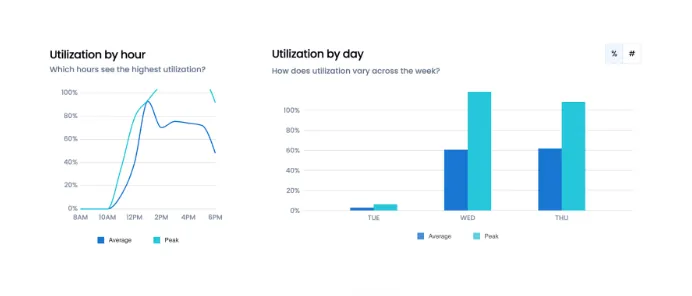
The data confirms what organizers hoped for: the World Workplace Expo Floor functioned as a vibrant mix of exhibitors, attendees, and networking energy, becoming the go-to destination each day.
Data-Driven Planning for Future Events
This collaboration with IFMA exemplifies how data-driven decisions can elevate experiences for both organizers, participants, and center hosts. Opportunities to enhance future events include:
- Right-size session rooms based on demand and timing patterns
- Leverage high-traffic windows for strategic programming and exhibitor engagement
- Optimize IFMA Central’s layout based on zone performance data
- Use environmental metrics to validate that spaces aren’t just occupied, they’re fostering the collaboration and connection that defines great events
- Dynamically adjust HVAC to maintain optimal IAQ while reducing energy based on real-time occupancy rates.
At R-Zero, we believe the future of building management lies in turning occupancy insights into action. Our Occupancy-Based Demand Control Ventilation (O-DCV) solution uses real-time space utilization data to automatically adjust ventilation and air delivery, reducing energy waste while enhancing comfort and air quality for every occupant.
If you’re looking to lower operating costs, cut carbon emissions, and make your buildings more responsive to the people in them, let’s talk. Let R-Zero help you with an energy audit of your space to see what occupancy-based controls can return in Opex while delivering valuable IAQ and utilization insights.